I came to TomKat Ranch this summer as a recent graduate with a Horticulture degree, a Permaculture Design Certificate, and years of experience working on organic vegetable and flower farms…
Seeing the Land Differently: A Season of Regenerative Thinking, On and Off the Ranch
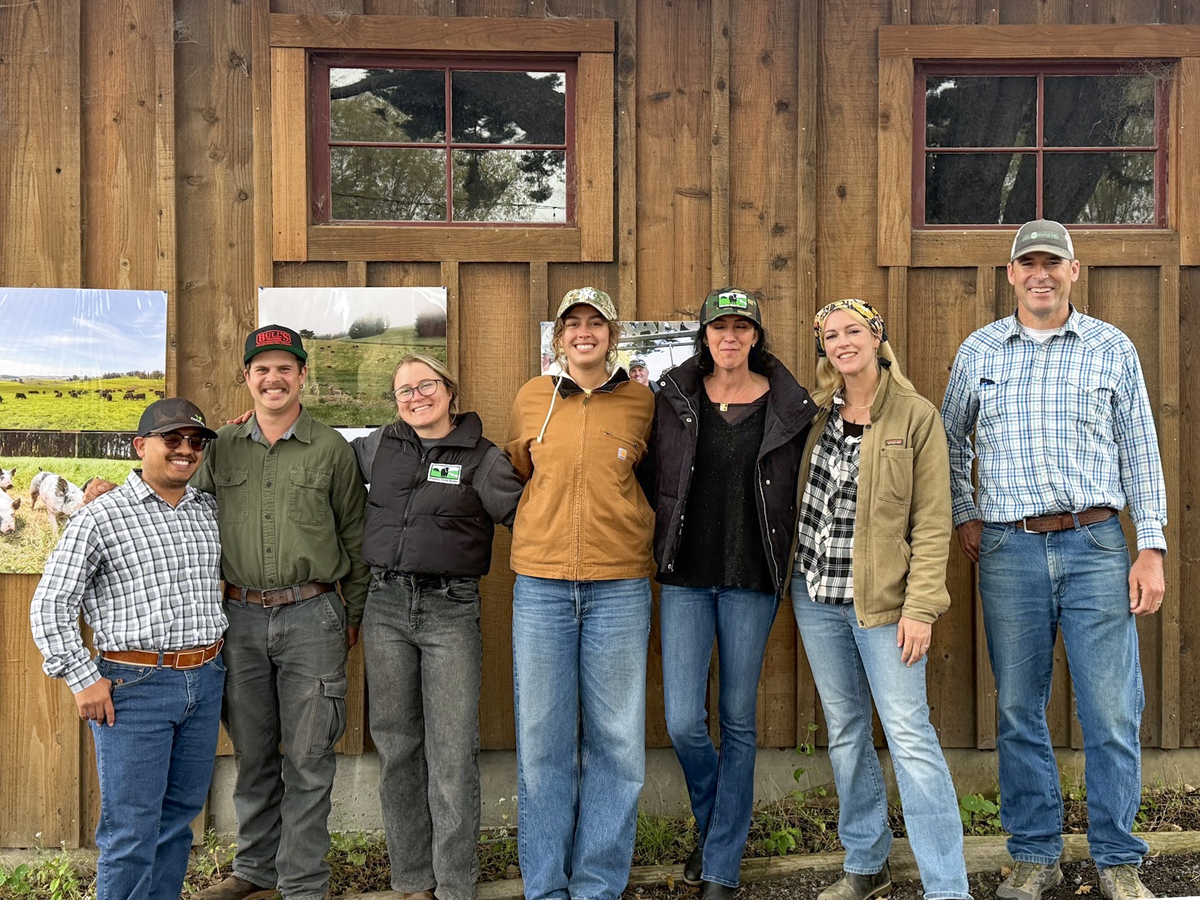
The summer intern visit to Stemple Creek Ranch. From left to right: José Gonzalez (TKREF intern), Matthew Habib (TKREF intern), Maddie Young (Stemple Creek Chief of Staff), Abby Garwal (TKREF intern), Jackie Bordessa (Stemple Creek Hospitality Coordinator), Sarah Carruth (TKREF intern and the article’s author), Alex Blake (TomKat Ranch Operations Manager).
10/16/2026
By: By Sarah Carruth, 2026 summer intern at TomKat Ranch
I came to TomKat Ranch this summer as a recent graduate with a Horticulture degree, a Permaculture Design Certificate, and years of experience working on organic vegetable and flower farms, but I had never worked with livestock. I understood soil health and plant systems, but I also wanted to understand how animals fit into the whole: how a herd could be a tool for land management rather than just a product taken from it. I got that education from TomKat Ranch, and then I got to see it again and again at other ranches and farms across the Bay Area. It turns out I wasn’t just learning a technique; I was learning to recognize a mindset, and once you can recognize it, you start seeing it everywhere.
Learning the Language of the Land
Most mornings started the same way: checking the herd, filling water troughs, and moving animals into a new paddock before the height of the day’s heat, but every move was a decision made according to our holistic land management plan. We split our cattle into four groups: two breeding herds on the home ranch and two off-farm groups—yearlings and finishers doing contract grazing for neighboring farms. The goats followed a similar rhythm: does and kids on farm, wethers and rams off-site doing targeted grazing for the Peninsula Open Space Trust as part of their invasive species removal work.
About a week into working with the goats, Mukethe, our Head Shepherd, gave me a copy of The Foundations of Holistic Management by Allan Savory, which, among other things, outlines the Four Key Insights that explain the dynamics that keep grasslands and other ecosystems in balance. This understanding completely reframed everything I’d been doing on the land and allowed me to see the bigger picture more clearly. Insights like how nature functions as whole, interconnected systems; the brittleness scale; the predator-prey connection; and how, when it comes to grazing, timing matters more than stocking-rate numbers.
Once I understood those principles, the plan made sense. Suddenly I understood why we moved animals every day or two instead of leaving them to wander. It wasn’t an arbitrary schedule; it was the entire method. And I started to notice its results under my boots: diverse forage where I might once have expected a single dominant grass, soil that held water longer than expected, and ground with visibly more structure and life than neighboring set-stock pastures. To me, that’s the real difference between conventional and regenerative grazing: conventional grazing takes things from the land. In contrast, regenerative grazing builds and replenishes life over time.
By midsummer, I noticed something in me had shifted from abstract knowledge into something more like intuition. I could look out over a landscape and guess whether the ground held more moisture or was more compacted. I could tell when a stubborn goat had its own ideas about where it wanted to be, and when a protective mother cow needed space. Low-stress stockmanship proved as important as any grazing chart. You can have the right plan on paper and still fail the animals and the land if you don’t also know how to calmly work with them.
Meeting A Shared Mindset
What I found most encouraging this summer wasn’t just what I learned at TomKat Ranch. It was seeing those same ideas and principles being applied everywhere else our field trips took us. It made the work here feel less like an isolated experiment and more like part of a broader movement.
At Stemple Creek Ranch in Tomales, California, we could see the results of this holistic approach to grazing as soon as we drove in. Their fields were noticeably greener than their neighbors’, serving as a visual testament to the positive impacts of their practice of planned grazing. Standing at that fence line comparing two properties side by side was the clearest argument for what regenerative grazing can do over time.
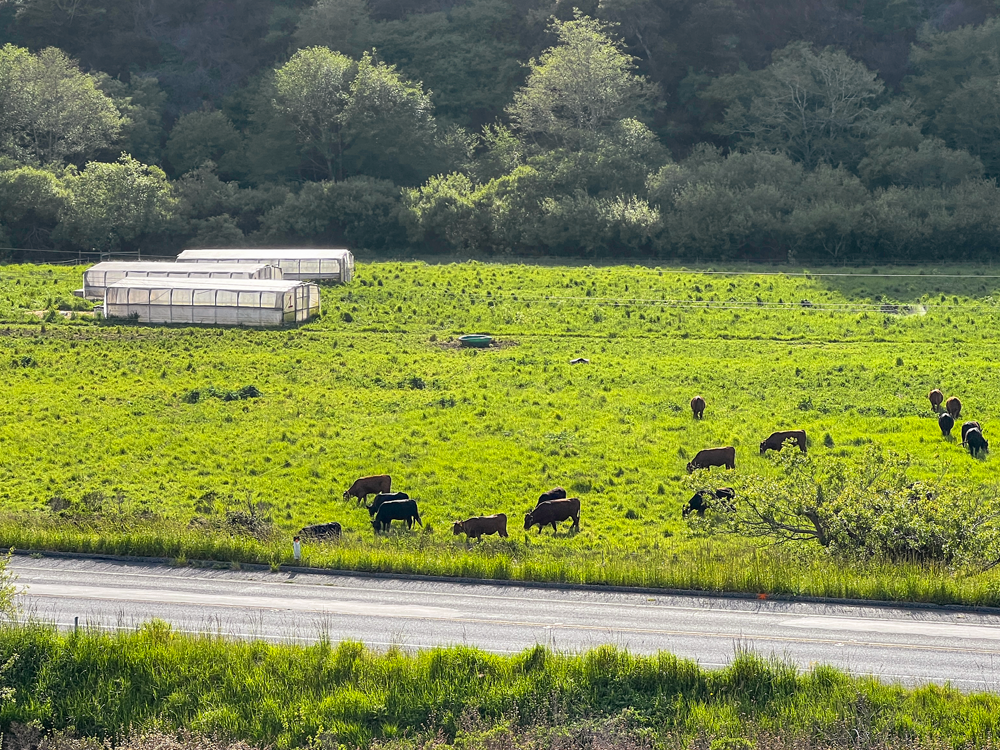
Root Down Farm mobile chicken tractors with TomKat Ranch cattle.
Root Down Farm showed me how this same idea could be done in succession with other livestock grazing plans. TomKat Ranch brought cattle into the farm to graze down tall invasive grasses like Harding grass, clearing the way for Root Down’s mobile chicken tractors to move across their fields. Watching two operations work together toward a shared goal of building up soil was a powerful example of what a mutually beneficial partnership can look like and how it can be used to further the cause of regenerative agriculture.
Brisa Ranch in Pescadero runs on that same logic. Early in the year, our cattle grazed down their cover crops, taking in the nutrients those crops provided while adding fertility back into the soil through manure, thus building organic matter in a way neither the cover crop nor the cattle could do alone. Cristóbal, Veronica, and Cole, the Brisa partnership, are also working with TomKat Ranch, Kitchen Table Advisors, and the San Mateo County RCD on a regional food hub to build a more collaborative and equitable food system that makes regeneratively grown food more accessible.
Red Dot Ranch stretched my sense of what “regenerative” could even mean. Mark Curtiss, a former biotech quality engineer turned farmer, and Karen Curtiss, a San Francisco-based architect, have built something that’s part farm, part gathering space, part climate research site. Their property is a working landscape designed to produce food, carbon-storing materials, and resilient infrastructure all at once. Seeing two people from such different backgrounds arrive at the same questions about how to live well in a place without depleting it was inspiring.
At the Eames Institute in Sonoma County, I saw what that same question looks like after decades of asking it. Charles and Ray Eames are best known as innovative mid-century designers who believed form should follow function: that the most elegant solution to a problem was the one shaped by its purpose. That same philosophy shows up on the working land around the Institute. The Institute’s adaptive grazing system grew out of a long partnership with Windrush Farm and, more recently, the Sonoma Mountain Institute and the Mickelson family. Each year their sheep are sheared, and the wool is spun and used to create textiles and other forms of fiber art created by artists during their residency. It’s a small yet tangible reminder that regenerative work can close a loop all the way to something you can hold in your hands.
Lastly, at North Bay Butchers, I got to see the other end of the production chain most of us don’t think about: a facility built specifically to reduce stress on livestock during the harvesting process and help local ranchers get their meat to market. It was a good reminder that a regenerative mindset doesn’t stop at the pasture. For a small rancher, access to a facility like this is often the difference between staying in business and not. Large-scale processing plants are built for volume, not for the handful of animals a small, diversified operation might bring in a season. A local butcher willing to work at a smaller scale and to handle animals with care means a rancher can sell directly to their community while also capturing the value of raising meat regeneratively, instead of having that story disappear into a supply chain built for mass production.
A New Way of Seeing
Now, when I drive past a field with cattle in it, I notice things I never used to see: the quality and diversity of forage, the telltale signs of soil health, and how water moves across the landscape. It’s become a kind of literacy. TomKat Ranch taught me how to read the landscape. The other producers and institutes we visited showed me the power of this literacy in understanding our role in stewarding working lands. The more time I spent on these farms and ranches, the more I realized that literacy was never just about reading soil or forage. It was about comprehending how our agricultural systems function as part of a greater whole and the impact they have on our planet.