
The first time I stepped onto TomKat Ranch I was aghast by its beauty. Back then, this landscape was pure enigma.
Part 1: Farewell Wendell
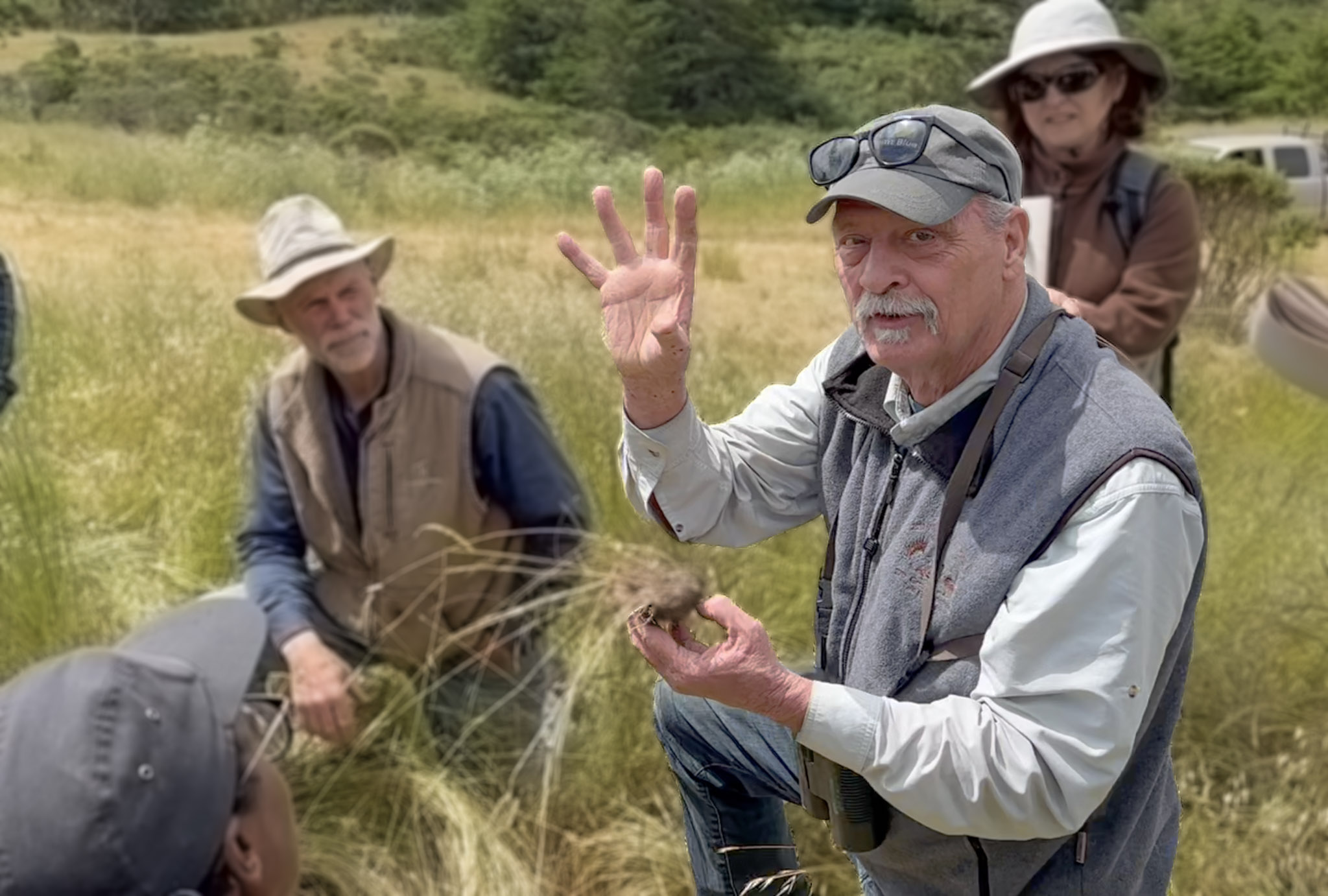
Wendell Gilgert at a soil workshop with TKREF staff. Photo: William Milliot
08/25/2026
By: Mukethe Kawinzi
Read Part II: Being A Steward—A Free-writing Exercise by Mukethe Kawinizi below.
The first time I stepped onto TomKat Ranch I was aghast by its beauty. Back then, this landscape was pure enigma. The sights, sounds, and language that began to wind my way were both alluring and mystifying; I had no framework for nitrogen fixation, herd effect, bulk density, or mycorrhizal fungi. I was a burgeoning shepherd eager to understand how historical human and animal impacts have led to ecosystem dysfunction, and to master the associated interventions that can spur along a healthy, biodiverse, working landscape.
One of the great pillars of that demystification has been the mentorship of Wendell Gilgert, whose infinite patience and rampant optimism have been foundational to our work at TomKat Ranch. For two years, he regularly came to the ranch to lead the Land and Livestock Team in a series of investigative pasture walks. From creek assessments to bale grazes to soil pits to prescribed fire: we wandered these acres with a different focus every month, engaging in explorations and discussions to refine both our ecological gaze and our work on the land.
Before his recent retirement, Gilgert spent a proud lifetime of hands in the soil. He helped nurture resilient landscapes through his work with Natural Resources Conservation Service, Point Blue Conservation Science, the Wild Farm Alliance, and beyond. Throughout his career as a conservationist, he directly and indirectly stewarded hundreds of thousands of acres while guiding soil scientists, ranchers, and biologists across the nation. His work has nurtured uncountable flora and fauna—from waterfowl to dung beetles, from stipa pulchra to elymus glaucus, from ground-nesting bees to scrub oak trees—into being and flourishing. He shares his knowledge with humor, humility, wisdom, and fervent inspiration.
On our final official day traversing the land with Gilgert, he led us in one of his quintessential exercises—an hour of deep looking and listening where we were invited to harness all of our senses and jot down our ecological observations. As we gathered together to share our collective thoughts, I was reminded of the transformative power of attention, and that every drop of water and every blade of grass is an opportunity for healing.
Wendell: We say farewell to you with great gratitude, hungry to use the attunements you’ve gifted us and ready to share your teachings far and wide. After all, when it comes to mentorship, there are no real goodbyes; the imparted knowledge persists as it is used, inhabited, and passed along. Indeed, every time I see a spiderweb, I think of you.
Part II: Being A Steward—A Free-writing Exercise by Mukethe Kawinzi
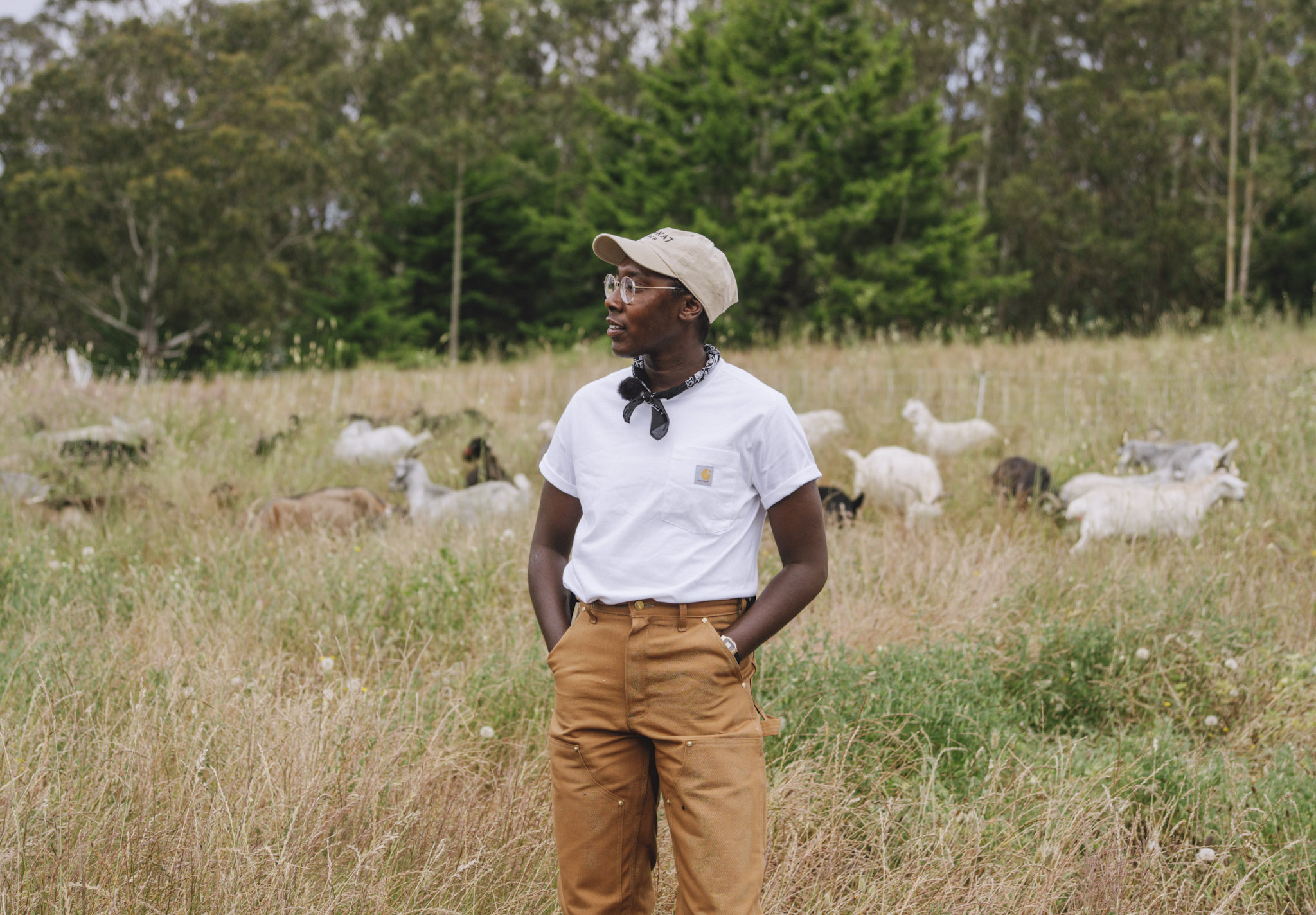
Mukethe Kawinzi, Head Shepherd at TomKat Ranch, standing in a pasture with the goats and the knowledge Wendell shared with her. Photo: AmaYah Harrison
I’m sitting at the intersection of three recent management choices we used in this landscape: goat grazing that was paddocked (and thus relatively heavy), goat grazing that occurred in conjunction with herding (and thus relatively light), and an ungrazed immensity of tight brush, totemic and imposing in the landscape.
Bird song is distant but present. While I cannot recognize the specific calls I can hear distinctions—some are chirp-like, others waft more melodic. I see a redtail riding the wind. I hear insects; again, I don’t yet have an attuned enough ear to say who is flying in my proximity, but they are present both beneath me in the forage and airborne. There is buzzing that fades in and out, someone is fluttering in the old and new grasses that surround me. A scrub jay, lazarine against the relatively pale ocean miles away, rises and seeks a new resting place.
And yes, from an anthropogenic perspective there is much to be heard as well: planes are flying overhead and heavy trucks rumble in the distance. If I look south, buildings and cars fill the view, backgrounded by fields of cultivated agriculture. To turn my gaze 180 degrees in the other direction gives me an entirely different perspective: on our land, utile structures of water tanks and solar panels dot an increasingly familiar sweep of the natural world.
The goats recently occupied this pasture to work on brush encroachment. Coyote brush is working its way in from the perimeter, colonizing space that was once, the soil tells us, grassland. In front of me are more decadent structures—older plants whose craggy branches have begun to reach tall toward the sky, adorned with crispy leaves that as they age seem to settle into an unpleasant pea green. Oh, coyote brush. When sprinkled through the pasture, the brush reads entirely non-threatening; a home for fossorial mammals, habitat for birds, shade for passing animals, and a diversifying food source for the herd amidst oxidized grasses and early-season forbs.
But the expanse of field in front of me shows how quickly this can shift. There is an acre that has become almost exclusively brush, and on the periphery is a hint of the diversity that I assume has been crowded out within: bare stalks of bristly oxtongue and dried milk thistle with a few magenta flowers that survived the fall. Germinating beneath Harding grass litter are infant vetches—fresh and juicy on the tongue—new oxtongue leaves that taste of pale arugula, and cotyledons that I haven’t the faintest idea what they will become. And yes, alas, here on the edge: tiny new sprouts of coyote brush, unduly cute—a looming harbinger of spreading yet to come. Further in the distance the patch that looked nonthreatening moments ago now feels like the beginning of an ecological stalker film. Just beyond that acres and acres that have already been colonized. Are we being hunted? Have we already been overtaken? Who is the prey animal here, exactly?
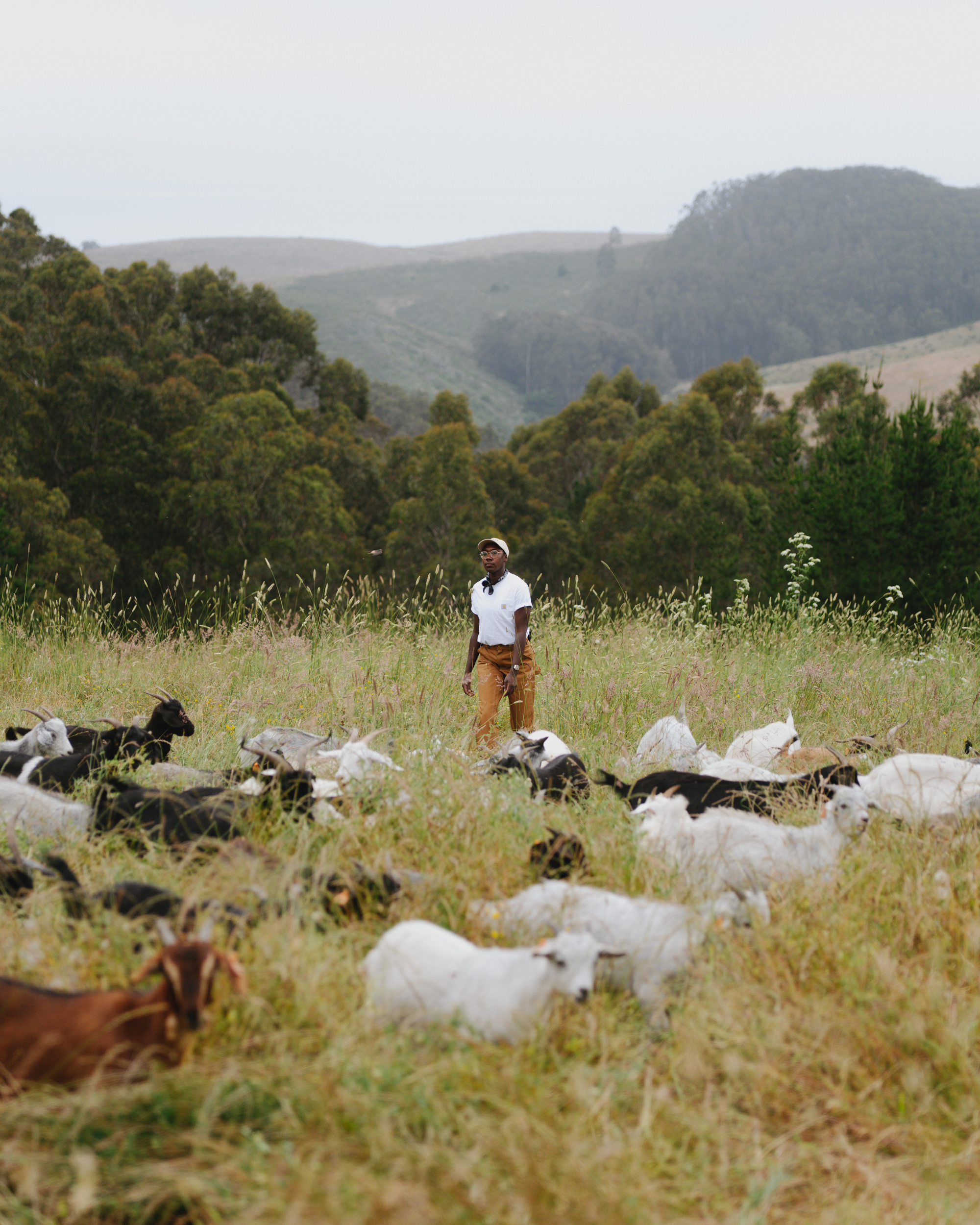
Mukethe Kawinizi in a field with her goats. Photo: AmaYah Harrison
5% brush cover here, 10% brush cover there…how swiftly does it become 50%, 70% and beyond? We need more hooves and more mouths, yes, but also more machetes and chainsaws, more uses for more of these plants, more fire, more time certainly. More creativity.
But it’s not meant for me to eat—that’s what the ruminants are for. What they evolved to do and why they exist so serenely in this landscape. Goats are doing good so far on the coyote brush this season. Defoliating, girdling, rubbing up on it for treasured scratches—the whole shebang. I look out at the plants they’ve hit hardest in recent weeks, pleased and proud. Coyote brush: it’s what’s for dinner, and also lunch, and also breakfast and dessert and elevenses and afternoon tea.
Yesterday, the Small Ruminant Team discussed expanding the role of the shepherd, by which we really mean returning to the ancient role of the shepherd. There is more to accelerating and layered practices than eventful burns every few years or hulking machines crushing branches beneath their implements. There is also that which can be accomplished with human hands. How many of these foreboding starts could I pluck in fifteen minutes? In an hour? In a day? How much could that support the healing of this one pasture? I rip a couple of sprouting coyote brush from the earth in quick deference to this new practice, decided upon not yet twenty-four hours ago.
I am hearing new birdsong, something more sing-songy, and still far away.
The soil surface is cool. I’m surprised at how dry it doesn’t feel, considering the weeks since last rain. This earth is blocky, with unfurling dreadlocked roots–the classic good signs. But every time I ogle soil I think most about what I can’t yet see.
It smells fresh and is soft enough to dig into with my fingers–obvious biological activity has decomposed what would-have-been-thatch, possibly helped along by the fog regime up in these high parts of the ranch. The soil is crumbly but clearly has moisture. Perhaps I shouldn’t be surprised—we are well within the rainy season after all—but the ranchers I’m surrounded by like to freak out fast about the rain, and make daily conversation about their fears. If it is not the lack of rain, it is that there is too much, or that it has been too cold, or that it has been unseasonably warm, have you noticed?, and what if what if what if what if??? What I’ve learned so far is that the earth persists.
Not that we can’t help it along. Goats took nearly all the seedheads off the Harding grass and I don’t know to whom that will give a fighting chance but maybe something exciting—something native, something perennial, something hereto unforeseen within these 1800 acres—will pop up as the months go by. I welcome the seedbank’s coy mysteries. Migration, transition, and dispersion: they are playing their part, the goats. I’m looking at the dung they’ve left behind, and the pink-thorned blackberry stems they quick-stripped not so long ago. They might deserve the title of steward more than us humans. Or maybe, like a multi-generational herd of ruminants each nibbling at a different plant at a different height in a different way, it’s a collective project in which we each play a role.