
We recently connected with one of our interns, Jack Towers, who shared that he graduated from Harvard with majors in Environmental Science and Public Policy and Integrative Biology.
Where Are They Now: Jack Towers
03/27/2026
By: Jack Towers and Kathy Webster
We recently connected with one of our interns, Jack Towers, who shared that he graduated from Harvard with majors in Environmental Science and Public Policy and Integrative Biology. He also holds a culinary arts diploma from the prestigious Le Cordon Bleu Institute in Paris, France.
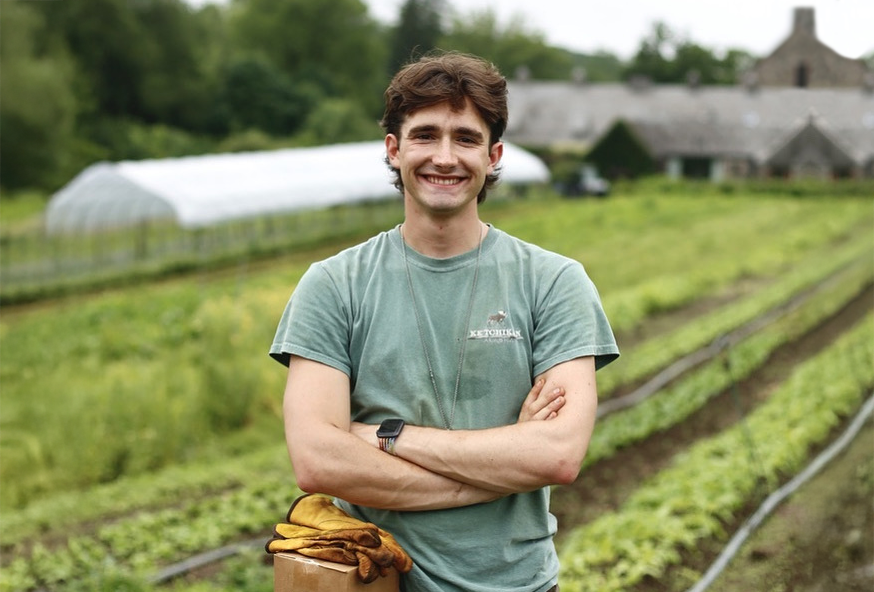
Following his graduation, Jack spent seven months as a seasonal crops farmer at Stone Barns Center for Food & Agriculture. We were thrilled to hear about his recent relocation to the Bay Area, California, to join the Agricultural Institute of Marin (AIM) as the Farm and Food Business Resource Manager. We enthusiastically embrace Jack’s next chapter and his continued passion for regenerative food systems.
Jack shared his insights on how his time at TomKat Ranch helped shape his career path.
How did you find out about TomKat Ranch?
I was fortunate enough to connect with Wendy Millet while seeking career advice during my junior year. As I learned more about her professional trajectory and the work that takes place at TomKat, I grew increasingly interested. I have always been passionate about the intersection of food and sustainability, and learning about TomKat’s approach to regenerative practices and land management resonated strongly with my personal interests in improving the sustainability of our food systems. When she shared the summer internship program, I was eager to apply and incredibly grateful for the opportunity to join TomKat for the summer.
How did you get involved in agriculture/ranching in the first place?
My family had a background in cooking and restaurant management, and so I grew up in a household where the choice of what to eat every day was conscious and thoughtful. Sourcing mattered, whether it was consuming from local farmers’ markets, participating in CSAs, or developing our own home garden. As I came to learn more about the larger context of food production through my studies in environmental science and public policy, I developed an interest in understanding the potential for agriculture to make strides in sustainability and produce food that is healthy, sustainable, and accessible. I had just decided to write my senior thesis on sustainable agricultural policy when I was offered the internship with TomKat, and I decided it would be insightful to develop hands-on experience alongside furthering my knowledge of the realities, opportunities, and challenges of regenerative agriculture.
When did you work at TomKat Ranch, for how long, and what was your position?
I worked at TomKat Ranch during the summer between my junior and senior year of college in 2024 as one of four interns.
What was your favorite memory at TomKat Ranch?
Choosing my favorite memory at TomKat Ranch is hard. Highlights include exploring the property in search of lupines with Kim Kitchener, tagging kids with the small ruminant team, and getting hands in the soil on the raised beds managed by Master Gardener Susan Hadacek, as well as spending the evenings cooking, working, and connecting with my fellow interns.
Who was the most influential person during your time at TomKat Ranch?
This is another challenging question amongst an incredible staff of ranchers and educators. Learning from Kathy Webster about the local food system and opportunities for collaboration and growth is perhaps most closely aligned with my personal professional goals and interests. Exposure to some of TomKat’s partners, ranchers, and collaborators gave me hope and emphasized the power of communication and relationship building in driving real change and improvement in our food system.
Where are you and what are you doing now?
As of January 2026, I have just relocated back to California. After working with the crops team at Stone Barns Center for Food and Agriculture for six months, I started a new position with the Agricultural Institute of Marin. As their Farm and Food Business Resource Manager, I coordinate several support programs that strive to break down barriers for farmers and food makers to get off the ground and into markets. Through this work, I directly support locally produced, sustainable, and community-oriented food and collaborate with a network of partners and technical support providers to promote robust food systems throughout the Bay Area.
How did your TomKat Ranch experience shape where you are/what you are doing now?
My time with TomKat directly shaped my career. After spending my summer in Pescadero, I completed my senior thesis on the potential entry points for regenerative agriculture in US policy. This confirmed my interest in understanding sustainable farming and the barriers preventing producers from adopting sustainable and regenerative practices.