
Nerd Night is a longstanding tradition between TomKat Ranch and the rangeland science teams at Point Blue to share what we have learned over the past year and to “nerd out” on data.
Nerd Night Recap: Celebrating 10 Years of the Rangeland Monitoring Network
03/27/2026
By: Krista Fanucchi, Bonnie Eyestone, and Lishka Arata
Nerd Night is a longstanding tradition between TomKat Ranch and the rangeland science teams at Point Blue to share what we have learned over the past year and to “nerd out” on data. Past Nerd Night themes have included Celebrating Biodiversity on California Rangelands, Stewarding Life Belowground, Fire and Rain, and Conserving Blue Oaks in the Face of Drought and Climate Change. This year, in an effort to make the event more accessible to all of the Rangeland Monitoring Network (RMN) participants, Nerd Night was held virtually. The program featured a brief history of Point Blue, an overview of the newly launched RMN StoryMap, and a rancher panel with some longtime RMN partners. It was a fun and meaningful opportunity to come together and celebrate a decade of data, collaboration, and partnership!
The evolution of the RMN program and the partnerships that have shaped it over time can be traced to 2011. This is when Point Blue launched the Rangeland Watershed Initiative (now the Working Lands Program), led by Wendell Gilgert and Geoff Geupel, which included the Partner Biologist program with the USDA Natural Resources Conservation Service (NRCS). By leveraging federal Farm Bill funds, the Working Lands Program at Point Blue began expanding conservation practices across the state of California. Since then, up to 20 partner biologists have come through the program each with a deep respect for agricultural communities, ranching, and land stewardship. Six of these partner biologists have been in their positions for ten years or more, including the very first partner biologist hired in 2011. The team built trusted relationships with local landowners to implement practices such as streamside fencing to restore riparian habitat and pollinator hedgerows to boost on-farm biodiversity which benefitted both operations and ecosystems.
The program was going well, but consistent and standardized data that could help ranchers analyze impact across ranches was still needed. At the time, former Working Lands Director Libby Porzig was working on rangeland science at TomKat Ranch. She, along with a few others, thought: what if we created a whole network of rangeland study sites across the state that produced a shared, big picture of what worked, what didn’t, and what we could try next?
In 2014, with critical support from the TomKat Ranch Educational Foundation, the Natural Resources Conservation Service, The Bechtel Foundation, Regenerative Agriculture Foundation, and the 11th Hour Project, Point Blue’s Working Lands Team launched the Rangeland Monitoring Network (RMN). Since then, the network has been supported by The Elizabeth R. and William J. Patterson Foundation, Audubon Conservation Ranching, and many other private donors. A decade later, fourteen biologists in partnership with 145 ranches in 28 counties have together collected information on birds, plants, and soil: 2,375 bird points and over 500 plant and soil points to be more exact! In addition to this keystone dataset, the meaningful and lasting relationships that have grown throughout the network have been invaluable.These partnerships strengthen the network’s ability to navigate the many challenges facing ranching communities and ecosystems: including drought, extreme and unpredictable weather, and a shifting policy landscape that affects available resources.
“When I got the data it was really amazing. My first landowner letter was very thorough and insightful because I was taking over the ranch from my dad. It was just a really good zoomed in and zoomed out reflection of where our property was at at that time. Our relationship with Point Blue has been great. We’ve done five rounds of monitoring since, so we’ve got some pretty extensive data. I ended up with baseline data that I could use for my ecological outcome verified program that I did later with the Savory Institute.”
-Carrie Richards, Richards Richards Regenerative Ranch Owner, Yuba County, RMN partner since 2017
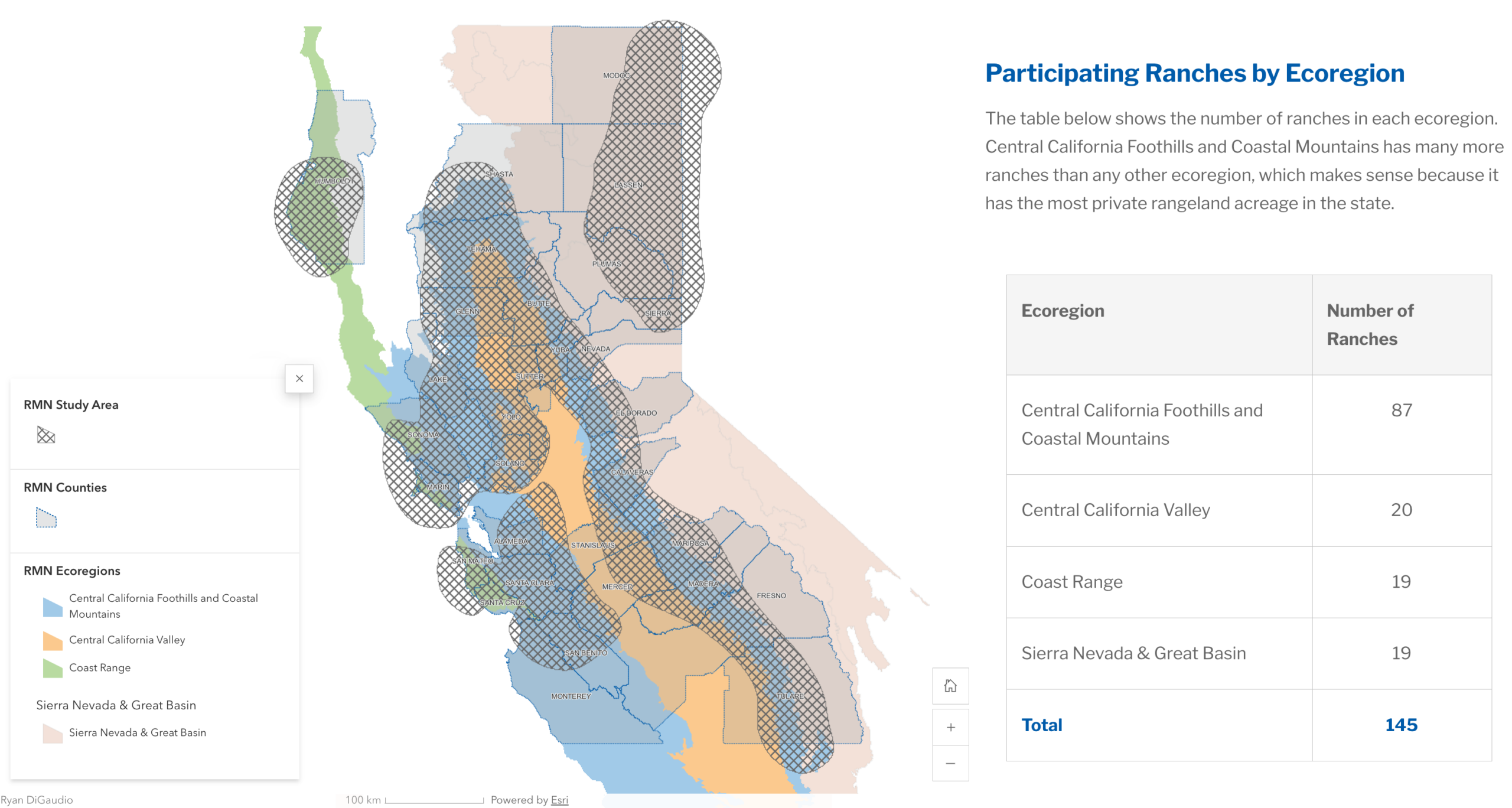
Participating ranches of Point Blue’s Rangeland Monitoring Network – Esri | USGS | Ryan DiGaudio
A Decade of Findings
Soils. Over the past decade, Point Blue’s research has shown that drought conditions are likely having a negative impact on soil carbon in rangelands. Even so, the soils in the network still hold a huge amount of carbon—an important component of healthy soils and resilient landscapes.
Understanding how climate, land management, and soil carbon interact is complex, but a lot has been learned through long-term monitoring. Confirming the strong influence of climate on carbon allows for the next step: exploring how different management practices affect carbon storage. The goal is to find strategies that can help protect and even increase soil carbon and soil health across rangelands. Point Blue has started this work through the Ag-C Monitoring Framework, led by Dr. Erika Foster and the Point Blue Soil Research and Conservation Program.
Plants. RMN data show that grazed grasslands provide a long-term, stable landscape for diverse plant communities to persist and flourish. Non-native annual grasses make up the majority of the plant biomass on California rangelands, and serve as an important forage resource for livestock. While this functional group of non-native grasses is extremely important to the economic vitality of ranches, the majority of the plant biodiversity on California’s rangelands comes from native wildflowers. In fact, California’s grasslands have some of the highest species richness and endemism of any habitat in the state, and a large proportion of California’s rare and endangered plant species are found in grasslands, including coastal prairies and blue oak savannas. Grazing helps maintain this diverse composition of plants and prevents complete conversion to non-native monocultures.
The RMN dataset also documented a decrease in three invasive plant species over the last decade: barbed goatgrass, medusahead, and yellow starthistle. This decline is likely connected to active invasive plant management by land stewards through a combination of prescribed grazing, prescribed fire, and other methods. This result shows that active management of invasive plants can result in significant reductions in cover, which is great news for both forage quality and biodiversity.
Birds. An impressive 248 bird species across California’s rangelands were recorded through RMN! Even better, many of the key oak woodland and grassland birds are holding steady, or even increasing in number. These are especially positive results considering that bird populations across North America, especially grassland birds, are declining at an alarming rate. A 2019 study estimated that the continent has lost nearly 3 billion birds since 1970, or a quarter of the total bird population. While California’s rangelands can’t reverse these national trends alone, Point Blue’s RMN data show they’re playing an important role by supporting healthy bird populations and offering vital habitat across vast, working landscapes.
“Ecological monitoring [from RMN] helps tell me where to focus my time and effort in a world that has finite time and dollars. That really really really really matters to me.”
-Byron Palmer, Grazing Manager, Sonoma Mountain Institute, Co Owner of Grounded Grassfed, Sonoma County, RMN partner since 2014
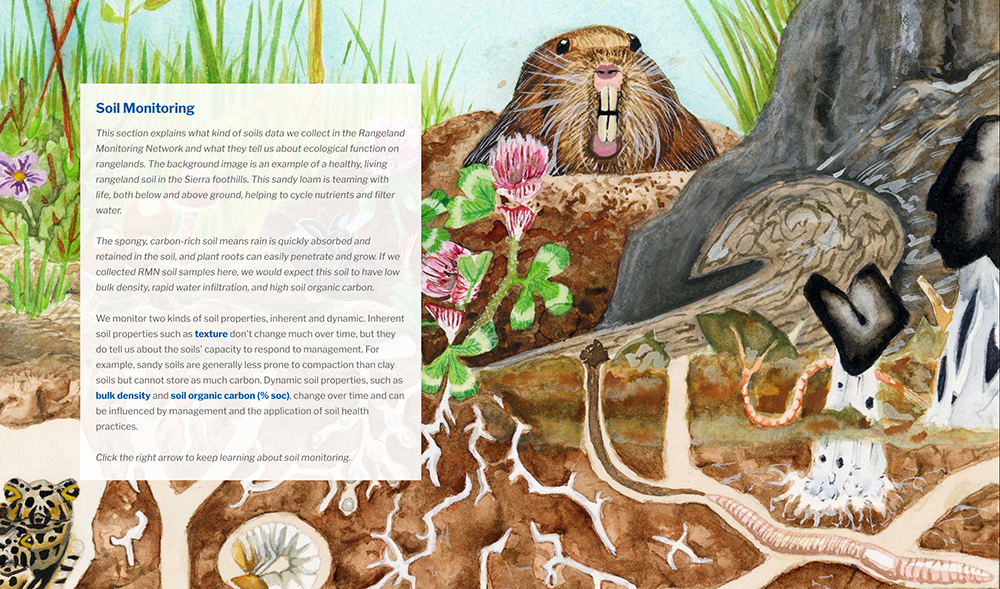
Illustrated by Mel Preston, reprinted from Life Belowground on the Range.
What’s Next?
Point Blue’s decade-long dataset, along with daily experiences on the ground with dedicated rangeland stewards, demonstrate the incredible value of California’s rangelands. Not only are they home to over 655,000 beef cattle and around 13,700 ranches, they play a major role in supporting biodiversity, carbon sequestration, and wildlife habitat across the state. Without the land base dedicated to economically viable livestock grazing operations, California’s rangelands are at risk of conversion to extractive forms of agriculture, industrialization or urban development, which threaten the biodiversity and many ecosystem services these landscapes provide.
As the Rangeland Monitoring Network enters the next decade, the program is positioned to further explore the connections between land management and the many ecosystem services that rangelands provide. A better understanding of how different management practices influence soil carbon storage, and identifying strategies that help reduce carbon loss, is a critical step. Continued collaboration with land managers will further develop recommendations that reduce invasive species and protect native plant diversity. At the same time, efforts will expand the focus on birds—exploring how populations on privately managed rangelands compare to established conservation goals, and partnering with stewards to enhance bird habitat through practices like prescribed grazing, oak plantings, riparian restoration, and more. This work aims to support both the ecological integrity and economic viability of California’s rangelands into the future. Key to all of this is maintaining and growing partnerships with ranchers, who have served as some of the state’s greatest land stewards.
“Ranchers aren’t the bad guy. They’re not out here trying to degrade landscapes. We work with multi-generation landowners that are excellent stewards of their lands, and honestly they’re the best people to be out there managing those lands. Ranching and livestock management is really important to local communities. It’s part of the community. Hopefully people can have more patience for cows crossing the road, and things like that.”
-Billy Freeman, Sierra Foothill Conservancy, Mariposa, Madera & Fresno Counties, RMN partner since 2014
If you’d like to learn more about our Rangeland Monitoring Network impact over the past decade and learn how to get involved, reach out to our Working Lands Director, Bonnie Eyestone at beyestone@pointblue.org and explore our new StoryMap at www.pointblue.org/rmn-storymap.