
For more than a decade, TomKat Ranch has invested deeply in monitoring its landscapes and documenting its grazing decisions.
Regenerative Ranching by the Numbers 2025 Wrap Up

TomKat Ranch Bulk density map.
01/21/2026
By: Shae Lynn Watt, Bookcliff Consulting
For more than a decade, TomKat Ranch has invested deeply in monitoring its landscapes and documenting its grazing decisions. Thanks to long-running partnerships with Point Blue Conservation Science, a commitment to transparent storytelling, and years of regenerative management, there is a remarkable body of ecological and operational data available on the ranch. That foundation has supported scientific research, community education, and statewide advocacy. Over time, the ranch has become a place where people can see regenerative principles in action, from changes in soil health to shifts in vegetation structure to the daily rhythms of moving grazing animals across a complex, diverse landscape.
A Simple Question
This year, our work centered on a deceptively simple question: What role can data play in regenerative ranching—specifically for ranchers making grazing decisions on the ground?
It’s a question with a long history behind it, and one where TomKat Ranch’s existing monitoring and data systems gave us a strong starting point. But as we dug into the details (not just the data itself, but the assumptions that shaped how it was collected) we found ourselves entering an unexpectedly important chapter. If the last decade was about building knowledge, then 2025 was about building clarity around the meaning of this knowledge.
Finding the Gap
The worlds of ranching and rangeland data have made strong progress in two major uses of data: scientific research and storytelling, however a gap still exists nearly everywhere we look: data that informs accurate grazing management decisions.
Rangeland monitoring partnerships across the US and world have generated meaningful insights about soil carbon, vegetation dynamics, biodiversity, and watershed function; outreach efforts have compellingly shared these findings with diverse audiences. The ecological story of TomKat Ranch, as an example, is well-documented, well-studied, and widely communicated.
From conversations with ranchers, scientists, conservation partners, and technologists, however, it’s clear that management-focused questions—questions like How much rest does a field actually need? or Which practices matter most under drought conditions?—are not being answered to land managers’ satisfaction by these efforts. It’s not that the data is “bad,” but it did signal a gap.
While initially disorienting, this discovery was a relief. Ranchers interested in data often talk about how they need to collect more, work harder, or adopt more complex tools to answer management questions. As we learned, however, the issue isn’t “more effort” or “more data”, it is about aligning land management questions with the data collection and analysis efforts capable of answering those questions.
This insight shaped our year.
Learning Together
Early in 2025, TomKat Ranch started the California Regenerative Grazing Data Collaborative with a small cohort of regenerative ranches to compare notes and learn from each other. We quickly saw the same patterns repeated across operations: ranchers who had invested heavily in monitoring and documentation still found themselves unable to answer basic management questions.
When these ranchers compared notes, a helpful truth emerged: the root challenges they faced were shared. Most ranches struggled with two structural issues—data that wasn’t organized around clear questions, and systems that couldn’t easily communicate with one another.
Naming these challenges opened up new possibilities. The ranchers saw that the challenges that were frustrating them weren’t the result of failed effort or skill, but a design issue. From there, the tone of the conversations shifted. The group’s work became less about “fixing” individual systems and more about reimagining the entire approach to management-oriented data.
TomKat Ranch’s Dashboard Project
TomKat’s own work illustrated this shift. Another one of our goals in 2025 was to explore how rest and recovery, the cornerstones of regenerative grazing, relate to ecological outcomes on the ranch. We paired TomKat’s extensive management records with years of monitoring data and built a series of dashboards to visualize relationships between cumulative rest and metrics like vegetation cover, bare ground, water infiltration, and species composition.
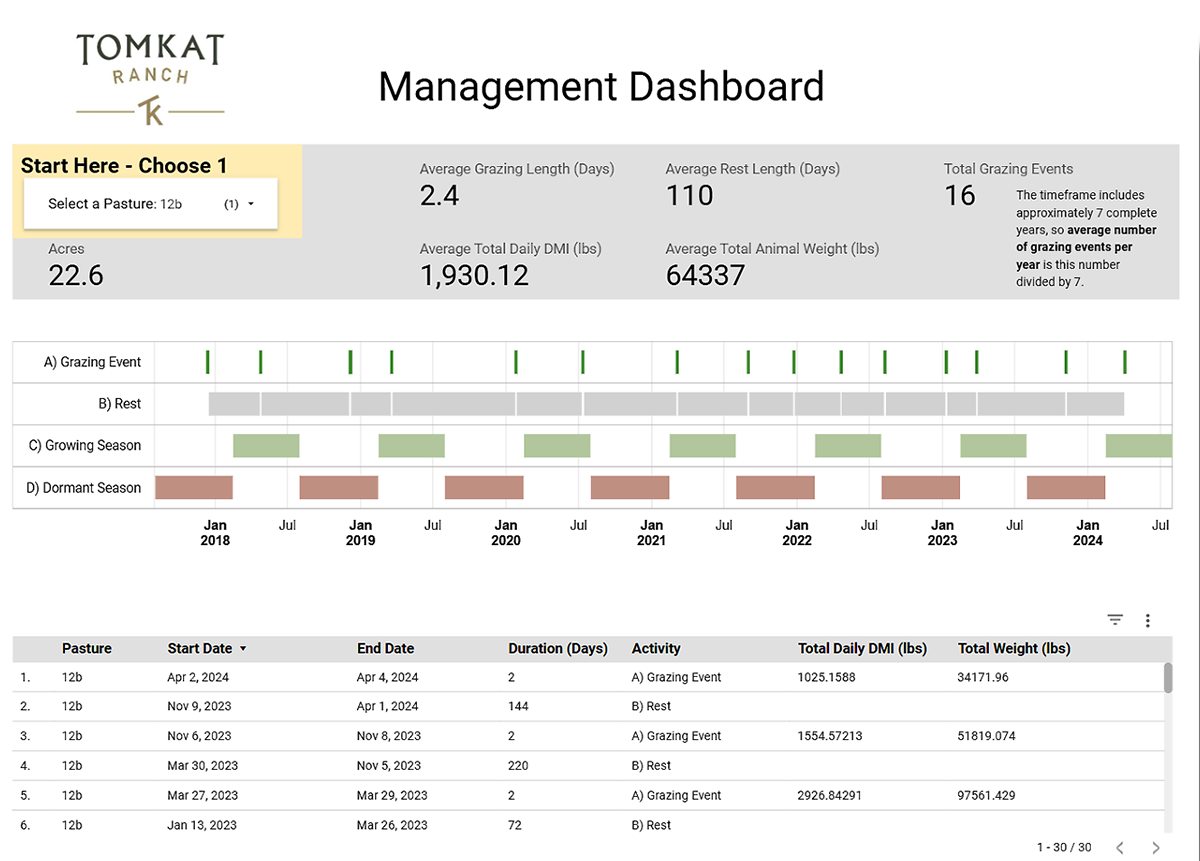
TomKat Ranch’s dashboards to visualize relationships between cumulative rest and metrics like vegetation cover, bare ground, water infiltration, and species composition built from their extensive management records with years of monitoring data.
The dashboard immediately revealed two important insights. First, TomKat’s grazing practices were consistent enough that rest periods often fell within a fairly narrow band, with less than 20 days of grazing per year on nearly every pasture with a monitoring point. This not only reflected intentional, high-quality management, but it also meant there wasn’t as much variation to analyze as we initially expected. This reduced our ability to explore how impactful rest and recovery were. Second, when we compared ecological outcomes against cumulative rest, many metrics were already within TomKat’s desired range. In other words, the ranch’s regenerative practices had created stability in areas where many other landscapes still showed dramatic variability.

Bookcliff Consulting for Percent Bare Ground by Cumulative 1-Year Rest data page.
While all these findings were signs of success, not problems, they clarified why management-specific analysis can be difficult. When a ranch has already reduced overgrazing and improved ecological function, some of the questions become subtler. Identifying that next level of insight requires more refined tools and more precise variation than traditional ranch monitoring systems were designed to handle.
Context Matters
As we continued to work through this process with TomKat Ranch’s land management team, another key theme emerged: context matters. When managers could identify which fields each data point represented, they could immediately point out meaningful ecological differences (e.g. north-facing slopes versus riparian corridors, legacy cropping histories versus undisturbed areas). These contextual nuances are obvious in day-to-day management but often invisible in aggregated datasets. Seeing how results varied based on subtle differences helped reinforce what regenerative ranchers have always known: thoughtful interpretation will always require people who know the land.
New and Renewed Tools & Efforts
Across the country, several new and renewed efforts emerged to address the structural limits of existing tools. Each of these efforts bring in different motivations, perspectives, and resources, and their convergence reflects a growing recognition that better systems are both necessary and possible.
- Northway Ranch Services: a relatively new company built by ranchers for ranchers developing tools designed explicitly around management decision-making.
- PastureMap: a commonly used management tracker reevaluating its data structures as part of its work with carbon market protocols, opening an opportunity to improve export and interoperability.
- Grazing Lands Carbon Data Initiative (GLCDI): a not-for-profit “multistakeholder trust alliance and shared data space” exploring how a shared data model might serve ranchers, ecologists, and conservation organizations alike.
- The Western Rangelands Data Initiative (WRDI): A committee of ranchers, conservationists, scientists, and advocates across the American West focused on public land grazing and regional resilience. WRDI emphasized stakeholder-driven questions and reinforced many of the same issues and questions seen at TomKat Ranch.
At the REGENERATE Conference in November, we co-presented with Byron Palmer from Sonoma Mountain Institute to share insights we’d gained in a session called “What Role Can Data Play in Regenerative Ranching?”

REGENERATE Conference in November. Shae-Lynn Watt from Bookcliff Consulting co-presenting with Byron Palmer from Sonoma Mountain Institute.
One attendee approached afterward with a comment we’ve come to cherish: “That wasn’t even boring.” The comment made us laugh, and told us we’re doing something important: striving to make data approachable, useful, and grounded in the lived reality of managing land and connect that data with tools that respect both the limits and the wisdom of hands-on stewardship.
Finally to wrap up the year of learning, the California Regenerative Grazing Data Collaborative members met in December to share plans and opportunities for working with data 2026 and noting that that work would be shaped by insights and alignment achieved in 2025. Together, we will be working to shape and co-create systems that answer specific management questions, with structures that make interoperability accessible across ranches. Members are experimenting with new tools or approaches, while others are revisiting long-standing datasets with clearer questions in mind. These twin efforts mark a shift away from collecting data with the hope it will become useful toward building intentional systems that support more confident, adaptive land management.