
In our first article, we discussed a new paradigm for thinking about the water cycle and its effect on climate patterns. This month, we share our thoughts about the role regenerative land management.
The Water Cycle, Part 2 of 3: A Land Manager’s View of Water
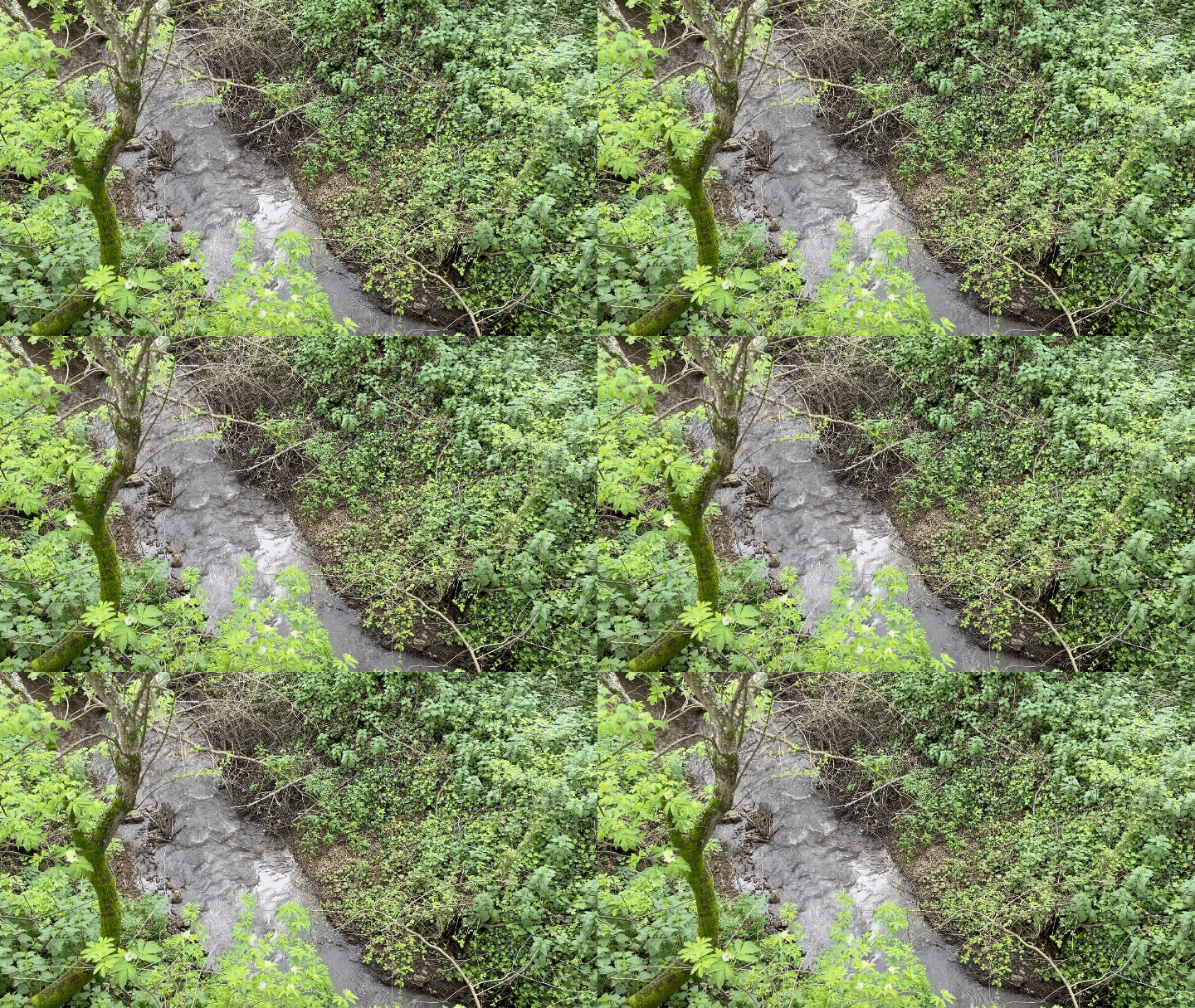
In the intricate dance of the water cycle, groundwater descends through the soils of TomKat Ranch, feeding the flow of Honsinger Creek. This stream journeys towards the Pacific Ocean, where it will ultimately evaporate back into the atmosphere, once more setting the stage for the formation of rain.
10/21/2025
By: Dakota Glueck and Wendy Millet
In our first article, we discussed a new paradigm for thinking about the water cycle and its effect on climate patterns. This month, we share our thoughts about the role regenerative land management can play in enhancing the small water cycle. By maximizing water capture in vegetation, soil, and ponds, land managers can not only make rainwater available for plants, they can extend growing seasons, enhance evapotranspiration, and even generate biogenic cloud-condensing nuclei that lead to rain.
New research suggests that when a land manager maximizes water capture on their land they may increase the efficiency of regional precipitation recycling. Evidence from various locations globally shows that when sufficient land within a bioregion is managed for optimal moisture capture and recycling, it can lead to increased precipitation and reduced storm severity, benefiting both the immediate area and downwind regions.
Why Regenerative Land Management?
To restore the small water cycle and natural ecology of drylands (such as California), regenerative land management is essential. Compared to humid lands, which more easily recover from disturbance by simply removing impacts, drylands, constituting 41% of the earth’s landmass, require the restorative impact of ecologically appropriate grazing by mammals and insects to cycle vegetation, feed soil microbes, build soil, and enhance the hydrological cycle.
Foundational Principles of Soil Health
To enhance hydrological function, ecosystem health, and productivity of the land, soil health is key. When soil is healthy, its ability to infiltrate, retain, and capture water is significantly increased. Capturing more rainfall means less moisture is lost to runoff and more moisture is available for recycling as part of the small water cycle. Healthy soil can also hold more moisture, thus it may boost evapotranspiration, prolong the growing season, and potentially provide essential moisture for late-season precipitation.
The Six Principles of Soil Health to Optimize the Water Cycle
The Six Principles of Soil Health offer a framework for developing and maintaining healthy soil, directly influencing a robust water cycle.
Principle 1: Know Your Context. Understanding the specific environment is fundamental for managing ecological function.
Principle 2: Minimize Soil Disturbance. This principle, along with Principle 3, focuses on enhancing the soil’s ability to absorb and retain water for plant use. Tilled soils lose structure and are susceptible to capping, greatly reducing the soil’s ability to capture and hold rainfall.
Principle 3: Maintain Soil Cover. Alongside Principle 2, soil cover promotes water infiltration and retention.
Principle 4: Maximize Diversity. Diversity across the small water cycle is key for the following reasons:
- Above and below-ground biomass: Catches and holds moisture more effectively.
- Diverse flora: Produce a variety of biogenic cloud condensing nuclei (bio-CCN) that aid in cloud formation.
- Diverse fauna: Lead to small disturbances within the ecosystem and diverse responses, contributing to more stable ecological function over time.
Principle 5: Maintain Living Roots. Roots help optimize both evapotranspiration and the production of bio-CCN.
Principle 6: Livestock Integration. Animals play a vital role in accelerating nutrient and carbon cycles, converting old plant material into fertilizer, and promoting plant growth. When integrated as part of a functional system, livestock can invigorate microbial communities that in turn retain water in the soil, help plants access soil moisture, and serve as bio-CCN themselves.
Building on a foundation of healthy soils, land managers can adopt a range of additional strategies to help manage water resources on their lands including:
Process-Based Restoration
Process-Based Restoration (PBR) refers to a suite of low-cost techniques that use simple, often site-derived, materials to make small interventions on the landscape that harness ecological functions and ignite land healing. The list of PBR techniques is long with each technique tailored to specific circumstances of erosion or degradation. Two common techniques are:
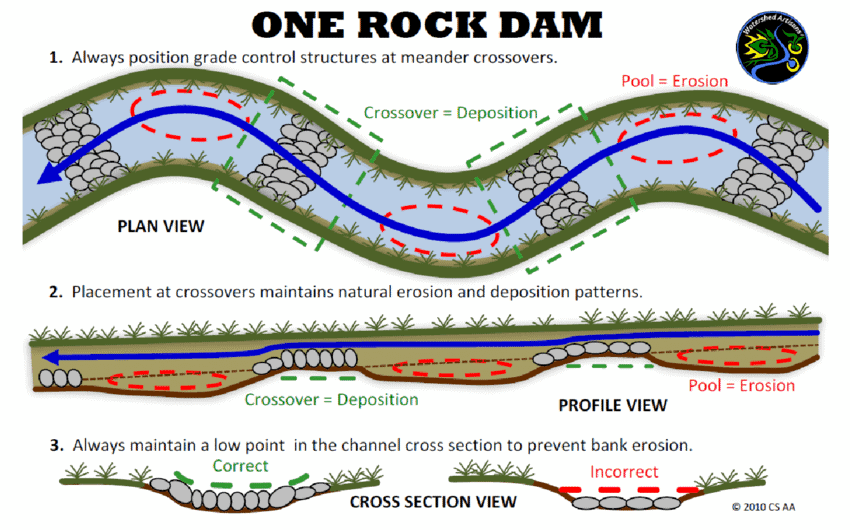
One Rock Dams (ORDs) are designed to combat upland erosion by targeting nascent gullies. A straightforward method involves placing a line of stones across the contour, near the top of an erosive feature and then repeating that process down the gully. ORDs function by slowing water when it enters the gully, allowing more time to permeate the soil. As the water’s velocity decreases, it deposits sediments which accumulate behind the ORD. The resulting increase in soil level and water availability encourages revegetation in the area behind the dam. As soil builds up and plants proliferate, new ORDs can be constructed until the erosive feature is fully restored.
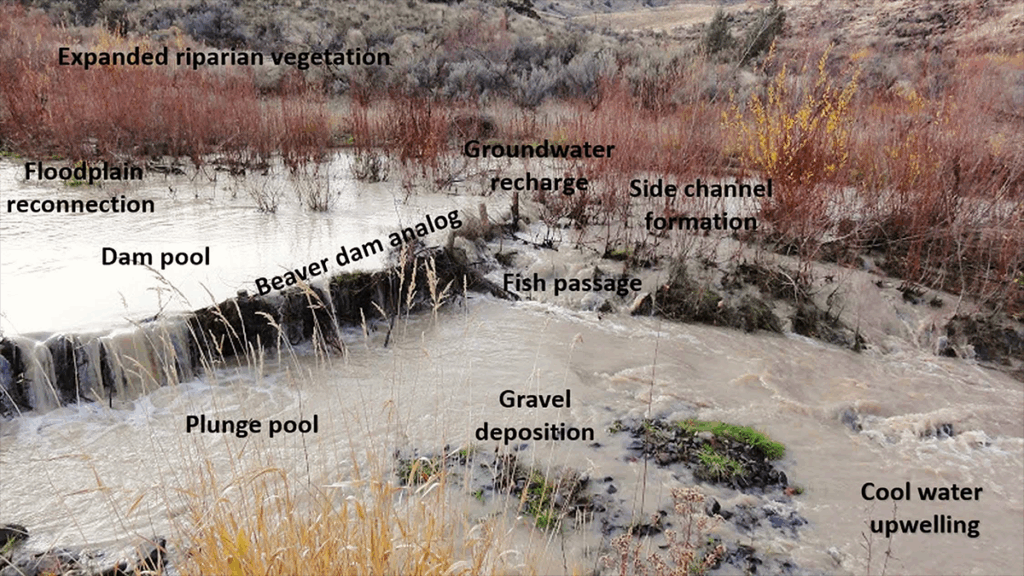
Beaver Dam Analogs (BDAs) operate on principles similar to One Rock Dams but are implemented within streams. As their name suggests, these dams are moderately sized and often constructed from natural materials typically used by beavers, such as soil, biomass, and, if appropriate, living riparian vegetation like willow. For larger structures or those in more unstable areas, driven pylons or securing cables may be necessary. The installation of a BDA in a stream creates a pool of still water behind a dam so sediments and stones can settle and gradually build up the channel floor. The still water also permeates streambanks, promoting vegetation growth and making water more accessible to plant roots in the floodplain.
Creating Leaky Water Retention Structures
Another method for enhancing the small water cycle is installing water-holding structures such as stock ponds, storm water basins, swales, reservoirs or imperfectly sealed ponds. Such structures “retain moisture” in the atmosphere, soil, and nearby vegetation. While it is important to maintain water levels in streams and rivers, holding water in “leaky” structures can moderate the intensity of high water events, sustain healthy flows later in the dry season, and create a slow-release system for the stormwater to make it into soil, springs, and rivers.
We suggest thinking of “retained moisture” in a similar manner as one thinks about “effective rainfall” (a term we discussed in last month’s article). “Retained moisture”, whether in human-made or natural structures, is an additional portion of total precipitation that would otherwise be lost to the small water cycle were it not for these structures. Like still water in ponds, retained moisture directly contributes to atmospheric moisture. As water moves into the soil, it directly contributes to plant growth and production of bio-cloud condensation nuclei (CCN).
Expanding Riparian Vegetation and Wetlands
Riparian Vegetation grows close to the water table of rivers, creeks, streams, and ponds so plant roots have easy access to water and participate in a phenomenon called hydraulic lift. Hydraulic lift happens when trees 1) respire and 2) take in moisture from the soil at the same time. The tension of the water, and the capillary action of the plants, causes moisture in the soil to rise and become available to shallower rooted plants. By expanding riparian corridors, land managers create larger areas where hydraulic lift makes soil moisture accessible.
Restored Wetlands slow and filter water, create evaporation, help to keep nutrients in upland ecosystems, and provide habitat for avian species and wildlife more broadly. Wetland restoration plans can double as flood mitigation plans, which protect infrastructure, habitat or forage from loss during high-water events.
Targeting Restoration to Impact Precipitation
As our understanding grows, we need to improve our ability to model and predict the effects that restoring landscapes can have on weather patterns. We need to understand the inflow and outflow of moisture on the landscape and the thresholds that trigger precipitation. As our understanding of these processes increase, specific restoration projects may be targeted to achieve specific effects o
- Placing forest restoration projects in the path of humid weather systems in order to contribute bio-CCN that trigger rainfall
- Restoring areas of significant elevation increase to enhance the orographic effect (when air rises and cools it loses its water holding capacity) triggering rain.
- Distributing restoration and various sources of evapotranspiration across the landscape to reduce air pressure, in effect inviting storms onto the landscape.
We look forward to continuing to learn about the potential benefits of innovative land management practices and how they can create multiple benefits for a landscape including increased water cycling, habitat enhancement, fire risk mitigation, and production. Perhaps someday, there will be an even greater promise realized when land managers across a bioregion work together to mitigate drought and restore water cycles and ecosystems—thus making land-based livelihoods more stable.