As the on-ranch science partner, Point Blue Conservation Science bridges the gap between rigorous academic science and interpretations of current science for land management in practice.
Creating a soil carbon primer
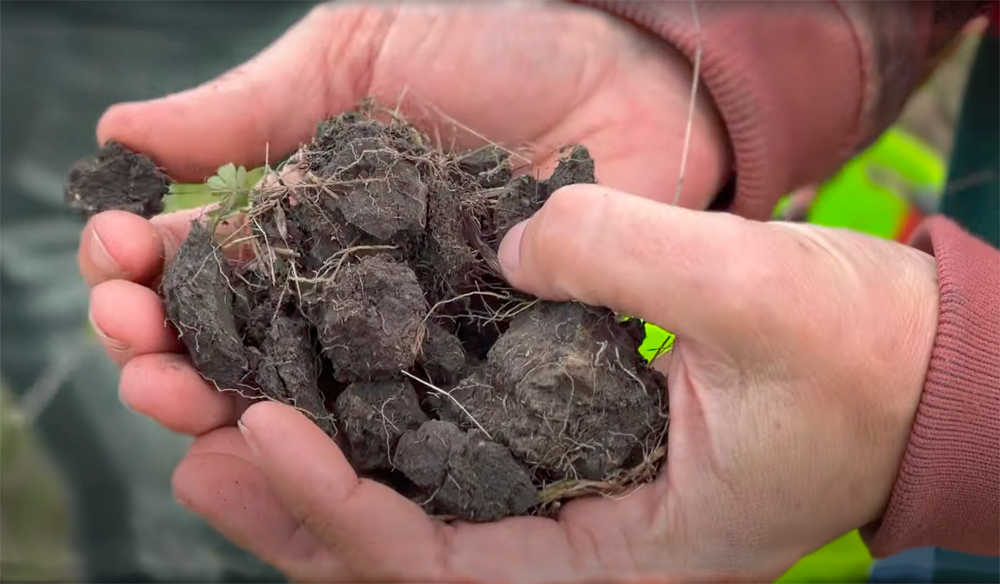
Erika Foster, Director of Soil Research and Conservation at Point Blue, holds a handful of soil from one of TomKat Ranch’s pastures. This particular pasture had been deeply tilled and compacted from previous management practices. Its deep color, crumbly texture, and abundance of plant roots show signs of improvement under regenerative management today.
09/15/2025
By: Erika Foster, Point Blue Conservation Science
As the on-ranch science partner, Point Blue Conservation Science bridges the gap between rigorous academic science and interpretations of current science for land management in practice. We sometimes observe bold patterns in our ecological monitoring work, like stream flow or the increasing abundance of certain perennial grasses and riparian bird species. At other times, our monitoring data require more nuanced interpretation and that’s when our team leans on ecological principles and theories to interpret results.
Currently our staff is identifying key patterns within soil science frameworks (from the past twenty years or so) as they relate to one of the most important indicators of soil health and every soil geek’s favorite topic: organic matter. We partnered with ten additional scientists across the nation (led by K. Rocci University of Colorado, Boulder) to untangle our understanding of soil organic matter in a new review article.
We found that existing research covers six main controls of soil organic matter:
- physical protection (soil aggregation or clumping of soil particles)
- attachment to soil minerals
- plant input chemistry
- site factors (climate and geology)
- diversity of soil chemistry
- soil microbes
Despite their importance, microbial influences on soil organic matter are the least explored. Both microbial abundance and their life histories (where they live, what they eat, and how fast and efficiently they process materials) can determine how much and how long soil organic matter is stored. Luckily TKREF and Point Blue have already been diving into this topic in the field. For more information on plant and microbial indicators of soil carbon, please see our previous report, Plant and Microbial Indicators of Soil Carbon.
We are thrilled to contribute to these in-depth scientific efforts to summarize and deepen our ecological understanding of soil health and are writing a new “Soil Carbon Primer” to create an accessible overview for all. This type of “in the weeds” work allows our team to understand how science evolves over time, which, in turn, helps us to reveal complex patterns in the field. All of this allows us to be confident in our recommendations for management practices on the ground.
Stay tuned as we finalize our new accessible “primer” on soil carbon. In the meantime, read the full scientific article of our collaborative findings here.