For nearly a century, the number of American farms has been in steady decline, from its peak of 6.8 million in 1935 to fewer than 2 million today.
Financing the Future of Regenerative Agriculture
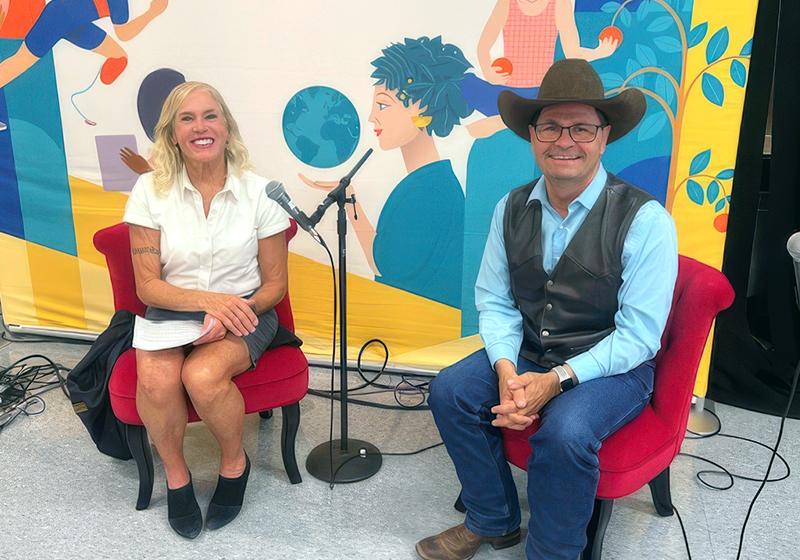
Kat Taylor with Zach Ducheneaux, former Administrator, USDA Farm Service Agency, at the SOCAP Global Conference.
08/19/2025
By Nick Ellis, Director of Research, Office of Kat Taylor
For nearly a century, the number of American farms has been in steady decline, from its peak of 6.8 million in 1935 to fewer than 2 million today. For the over 1.5 million small family farms still planting and harvesting across America today, times are undeniably tough.
The Farm Credit System, America’s primary farm financiers which is a network of lenders, issue loans to farm businesses based on demonstrated predictable income and sufficient collateral. Small farmers with lower incomes or limited collateral often receive risky, high-interest loans as their only option, locking them in cycles of debt, and making success and innovation even more difficult to achieve. Compounding this, the majority of crop insurance payments overwhelmingly go to very large, conventional monocropping operations.
Simply put, it is difficult for small family farmers to secure flexible, patient capital needed to invest in themselves, improve land stewardship, and grow their businesses over time.
At the Office of Kat Taylor, we’ve spent the last two years examining these pressing challenges to the future viability of American agriculture. However, we’ve also identified solutions to these challenges. Our thesis for change is simple: by increasing the loans from lenders who give farmers patient, flexible capital, we can demonstrate that small producers are not only viable businesses, but also highly profitable under the right conditions. Innovative farmer-focused loans can foster financial stability, enabling farmers to prioritize soil health, boost biodiversity, strengthen their climate resilience, and contribute more to local rural economies.
To advance this shift toward regenerative financing, we’ve hosted a series of convenings with investors and philanthropists to promote investment in alternative lenders that provide farmers with the capital they need. A key partner in this ongoing effort is Zach Ducheneaux, former Administrator of the USDA Farm Service Agency. At the SOCAP Global Conference, Kat and Zach spoke candidly about farm credit system reform and the need for new financing models that truly serve producers. Our goal is to inspire action from investor networks, foundations, and financial institutions who are eager to put resources towards giving small American farmers, and the lands that sustain us, a fighting chance. As this work progresses, we will continue to share opportunities, innovations, and insights that lead to a more just, regenerative food system— one where small ranchers and farmers can do what they do best, provide us all with nourishment and land stewardship.