
Through photosynthesis, it can be said that the whole world runs on sugar! See how organic matter is the glue that holds soil together through the demonstration of a Slake Test.
Meet our 2025 Intern Cohort!
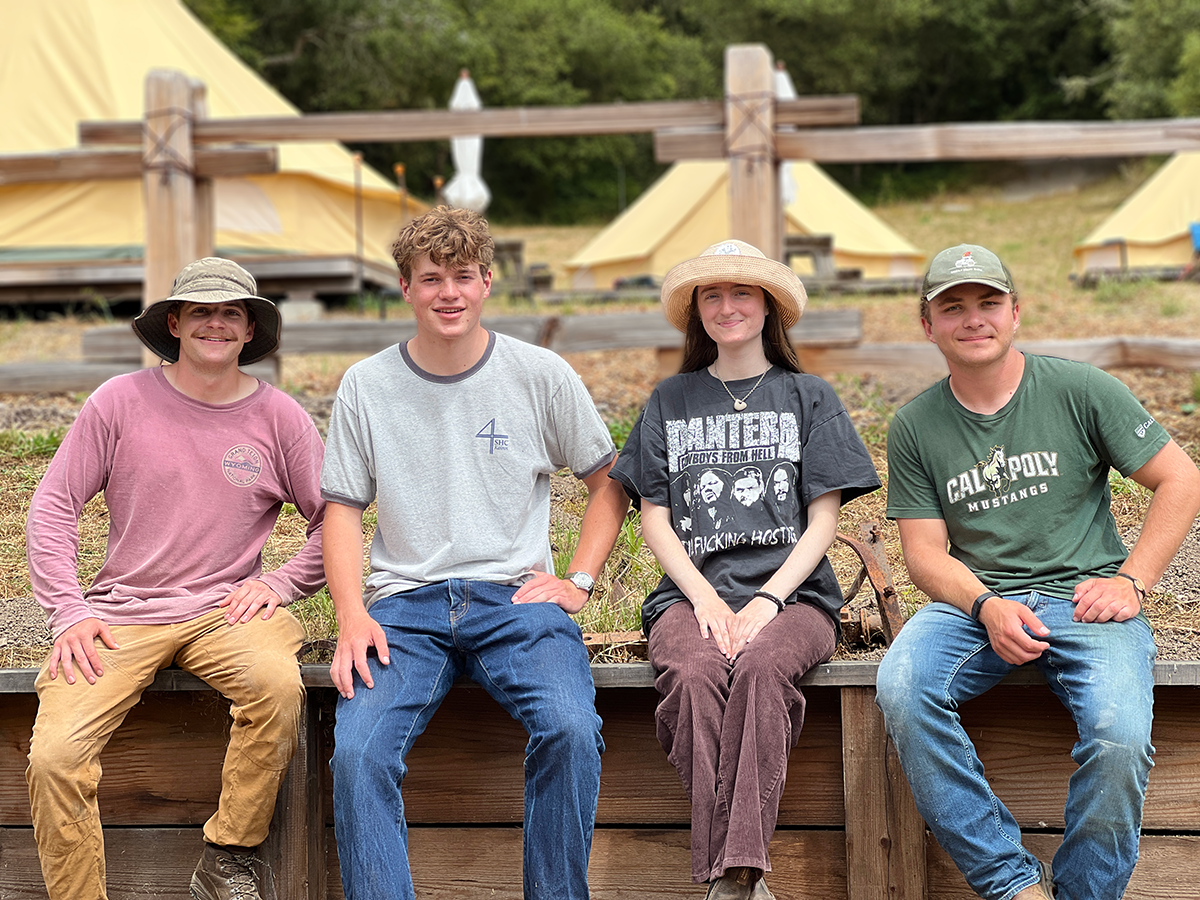
The TomKat Ranch summer interns. From left to right: Kelly Carmichael, Seamus Wille, Hannah Simon, and Owen Rockemann.
08/17/2025
By: Jessica Hartzell
This year’s intern cohort brings diverse backgrounds, unique perspectives, and an unwavering commitment to healing the earth through thoughtful farming. From knitting with natural fibers to agricultural engineering, these interns represent the next generation of agricultural leaders who understand that true farming success lies in nurturing both the land and the community it feeds.
Hannah Simon
For Hannah Simon, sustainability isn’t just a career choice—it’s a way of life that touches everything from the clothes she wears to the food she grows. As an obsessive knitter who creates garments from 100% natural, biodegradable materials, Hannah understands the intimate connection between land, animals, and the products that sustain us. Her dedication to educating friends and family about the reality of our clothing choices demonstrates a commitment to environmental awareness that extends far beyond her own practices.
Hannah’s hands-on experience spans from creating multiple gardens from scratch to working as an intern at the Kresge Garden at UC Santa Cruz. Her volunteer work as a goat milker at Vida Verde has given her direct experience with livestock care, while her bilingual abilities in Spanish and English—developed as part of the first cohort of the Spanish immersion program at Encinal Elementary School—will be invaluable in TomKat’s diverse agricultural community. For Hannah, this internship represents the perfect convergence of her passions: the opportunity to explore farm operations in Pescadero, a place she describes as “truly special,” while contributing to a more sustainable and connected future in agriculture.
Kelly Carmichael
Kelly Carmichael’s path to TomKat Ranch began with a bold decision a year ago: leaving Texas to learn “how to do agriculture the right way.” His journey reflects a growing understanding among young agriculturalists that farming must improve the health of entire ecosystems—soils, plants, animals, and ultimately, humans.
Kelly’s deep connection with the natural world led him first to ecological restoration and permaculture, but it was through his horticulture studies at Cabrillo College that he discovered holistic grazing as the connecting thread between all his interests. His experience spans nurseries, landscaping, and organic produce farming, developing high quality problem solving and independent thinking skills.
What sets Kelly apart is his dedication to continuous learning. He spends every spare moment studying how to play a role in healing the earth while providing nutrient-dense food to his community.
Owen Rockemann
Owen Rockemann brings a unique perspective to TomKat Ranch as a Cal Poly San Luis Obispo sophomore studying Biological Resources and Agricultural Engineering. While his particular interest lies in agricultural mechatronics and automation, his long-term vision is deeply personal: starting his own farming operation that combines technological innovation with sustainable practices.
Owen’s agricultural journey began with volunteer work at a ranch in Modesto, where his family was living. This experience provided him with fundamental knowledge of field maintenance, irrigation, and herd management. His role as assistant farm manager with the San Joaquin County Office of Education expanded his skill set to include brush management, fence maintenance, and sprinkler system upkeep, while also allowing him to accumulate hundreds of hours of tractor operation experience.
For Owen, TomKat Ranch represents more than just professional development—it’s a return to an area close to his heart. Having spent considerable time around Pescadero when his family first moved to California, he has a special affection for the region. His observation that “the cows on the bluffs overlooking the ocean have to be the happiest cows” is right on—we think so too.
Seamus Wille
Seamus Wille’s path to agriculture began in an unexpected place: the grocery store. Growing up with parents who are educators, particularly a father who teaches culinary arts, Seamus developed his love for agriculture through family shopping trips where ingredients and their potential were constantly discussed. This early exposure to the produce and meat sections sparked a curiosity that would eventually lead him to pursue sustainability within agriculture.
The turning point came during his AP Environmental Science class, where viewing “The Biggest Little Farm” documentary crystallized his desire to work in regenerative agriculture. What draws Seamus to TomKat Ranch specifically is the organization’s dual commitment to practicing regenerative agricultural methods and educating others about their importance. He recognizes that while practicing sustainability is crucial, educating and advocating for these practices represents an entirely different—and equally important—challenge.
Currently studying at Cal Poly SLO, Seamus has gained hands-on experience across various aspects of agriculture, developing both problem-solving skills and practical knowledge of agricultural practices. His goal extends beyond personal career success; he plans to “leave the earth better than I found it and push others to do the same.” This summer at TomKat Ranch, he is balancing his time between the hard work of managing the land, and supporting the science team with sampling and data collection.
Hannah, Kelly, Owen, and Seamus represent the future of agriculture: thoughtful, educated, and committed to practices that benefit both the environment and human communities. Their diverse backgrounds demonstrate that regenerative land management draws talent from many paths. As they round out their journey at TomKat Ranch, we are so grateful for the opportunity to host them and learn from their perspectives and fresh outlook on the possibilities of what regenerative agriculture can be and what it can do for our world