
In the first and second articles in our series Regenerative Ranching by the Numbers, we focused on how we are hoping to use data at TomKat Ranch.
Regenerative Ranching by the Numbers, Article 3

Agrology | ag installing their carbon sensor on TomKat Ranch
05/22/2025
By: Kevin Watt & Shae Lynn Watt, Bookcliff Consulting
In the first and second articles in our series Regenerative Ranching by the Numbers, we focused on how we are hoping to use data at TomKat Ranch. In these articles, we discussed a growing interest among local ranchers in using data for decision making. Today, we are going to explore how this looks across the regenerative ranching industry as a whole.
Data as a tool to inform agricultural practices isn’t new. In fact, it’s common practice for industrial farmers, and has been for many years. Since industrial agriculture seeks to simplify, standardize, and control as much of the growing process as possible, data- driven decision making is easier to apply.
This approach externalizes and tries to disregard many of the important, but complex, things regenerative agriculture focuses on, like ecosystem services, community connections, and context-specific adaptive land management. But it’s worth noting that industrial agriculture is correct in claiming it is much simpler to ask and answer, “Which fertilizer yields more pounds of corn?” when the corn, soil, water, and pest control are all standardized, and when fertilizer’s effect on local fish populations is not considered. This isn’t a dig at industrial growers; it’s an acknowledgement that data analytics are more clearcut within a standardized system that has a narrow set of living outcomes to consider.
Despite the complexity, data has been collected from regenerative ranchers for many years and even decades in some cases. Scientists, ranchers, and communities have long been interested in environmental outcomes like changes in soil carbon, bird populations, and stream flow. Ranchers, too, have tracked their incomes, animal health, meat production, and usage of supplement feed.
Regenerative ranching has always relied on close observation and adaptation, and so many in the field have relied on their senses and intuition to understand relationships on their ranches. What appears to be somewhat new is an interest in directly quantifying and connecting their management practices to business and environmental outcomes in an analytical way.
The first challenge these ranchers face is one of interoperability, which is described in the Farm Foundation’s 2021 Issue Report titled “Data Interoperability in Agriculture.” Megan Shahan defines interoperability as “the ability to exchange and make use of data between devices and systems”—–think of linking management data to weather and ecological monitoring data. Interoperability is often impeded by a number of technical hurdles, from incompatible programming languages, to data structures and definitions. While many tools are available, they are usually proprietary technologies focused on just one piece of the regenerative ranching data landscape (e.g. they separately track data about cows or grazing or soil monitoring). These siloed data collection systems make it difficult, if not impossible, for the average regenerative rancher to answer holistic management questions with data.
This history of data use in industrial agriculture and the rise of siloed data collection tools for regenerative producers is evident in the cattle tech sector map created by Terra Genesis and Nature Tech Collective in 2024 – Cattle Tech: Datasets and Technologies for a Sustainable Beef Industry. The 75 page document highlights expert opinions on the strengths and challenges of integrating technology solutions in the sustainable cattle industry. It lists a comprehensive set of technologies and datasets available in four areas:
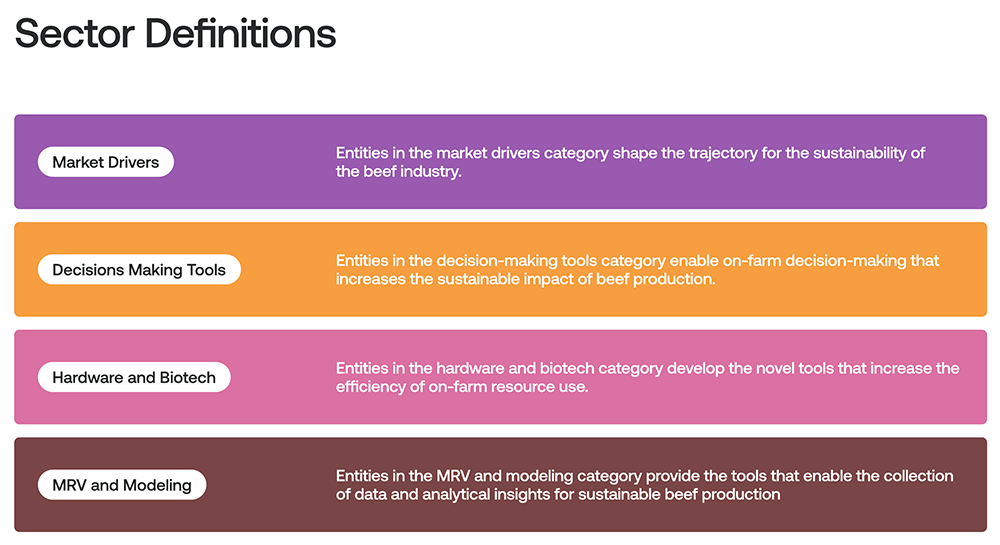
Illustration by Terra Genesis and Nature Tech Collective
The technologies within “decision-making tools” are categorized into feed management, herd management, pasture management, or record keeping. This means that ranchers are forced to cobble together multiple tools to track the varied information about their ranch operations, but those tools can’t easily talk to each other. As a result, to track both the veterinary records for a herd, the weights of the individual animals, and which pastures those animals grazed, a rancher would need two or three distinct tools, each with its own profile for every animal on the ranch.
Furthermore, those apps would be unlikely to integrate monitoring data. Thus, once all data is collected across a growing number of apps and tools, a rancher still wouldn’t be able to easily connect how management decisions impact ecological outcomes. While mapping the landscape of digital technologies and datasets that can help us understand the cattle industry is a tremendous starting point in using data to inform decisions on the ranch, the report itself highlights the challenge of interoperability.
It’s worth noting that interoperability challenges are exacerbated by the nature of regenerative management. Data standardization works best when categories are clearly defined. This sounds simple, but fluidity is key for regenerative management.
For example, herds are sometimes mixed, or a handful of animals are separated from the herd because of behavioral dynamics, or breeding changes, only to be added back later. While fences may appear to define fields with consistent boundaries, when a rancher observes that the lower side of the field is still soggy from a recent rain, they may move the portable electric fence to keep the livestock from overimpacting the easily compacted soggy soil. This type of context-driven adaptive management is wonderful for the land and animals, but can create a huge headache for ranchers trying to collect data on their management.
So what do ranchers need instead? There are a few paths forward.
First, everyone would benefit from a more open-source environment for both monitoring tools and the data that is collected. Confidentiality and data sovereignty are crucial, but there are ways to allow stakeholders in this industry to learn from each other while ensuring that privacy is protected and data is managed equitably.
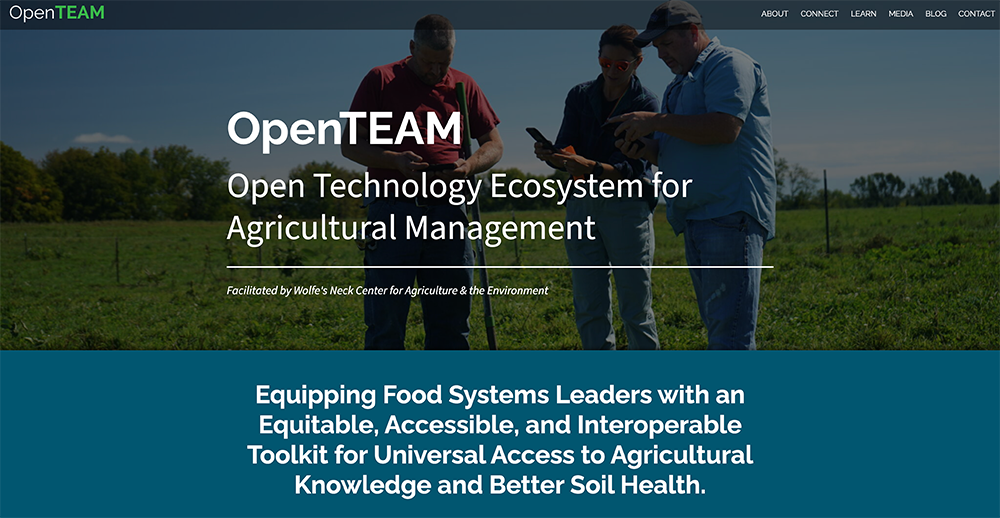
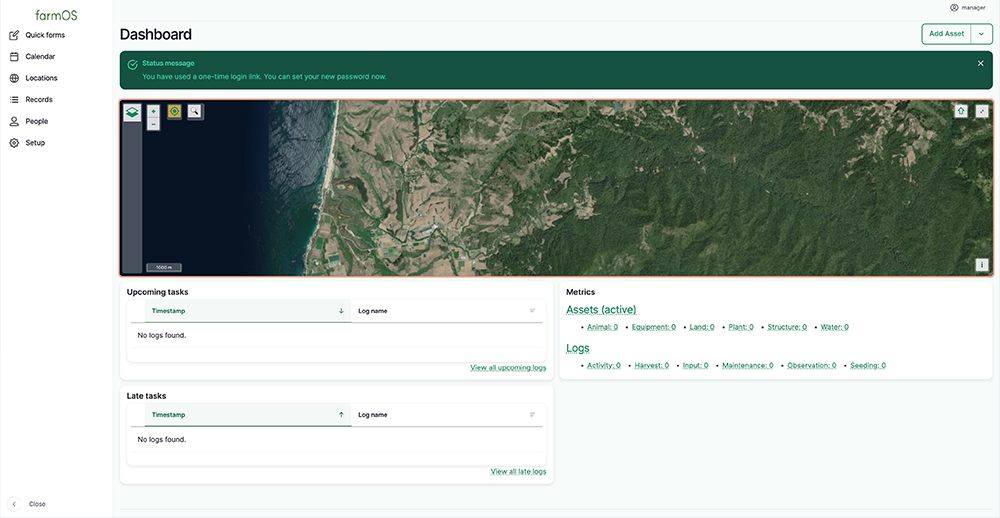
Efforts like OpenTEAM and farm OS have made great strides in these areas, but adoption has been limited. They set an inspiring example that could be applied to local and regional collaborations of producers who want to get better outcomes from their management decisions.
Second, ranchers and technology creators need to get clear about the questions ranchers want to answer, and build the holistic, flexible nature of regenerative management into the tools. This means that digital tools should accurately reflect how we draw boundaries on landscapes, define herds, and measure the state of the pasture. This flexibility must be part of the system, and not a laborious workaround inside of an inflexible system. In a perfect world ranchers and technology creators would work together to clarify and understand the unique needs of regenerative ranchers and the limitations of different technologies.
Third, the end product has to be actionable for ranchers. It’s not enough to collect data and hope it helps make the connection between management practices and outcomes. We need tools that explicitly create that connection. Not every tool has to provide this full scope, but every tool has to be built toward making that goal possible.
Ultimately, when we think about data and ranching it is important to remember that there will not be any simple fixes or “silver bullets.” In the world of agriculture, “precision farming” is a selling point and “precision ranching” is a punchline. Farms are relatively small, usually fairly uniform, and generate a lot of revenue per acre. In contrast, rangelands are massive, diverse, and often generate very little revenue per acre. This purely economic view disincentivizes innovation on rangelands. Luckily, the regenerative ranching movement has begun to improve its economic case while also bringing attention to the significant environmental and social value that can be created on rangelands.
Ranchers, educational institutions, nonprofit organizations, and government agencies are beginning to recognize the importance of empowering rangeland stewards with the tools and feedback they need to efficiently contribute a holistic, positive impact. As a result, a number of regenerative data initiatives have formed in the last few years and they are starting to inspire and support innovation and change. TomKat Ranch is enthusiastically participating in a number of these important collaborations and conversations. We believe that as the full range of potential benefits are understood and communicated, more and more ranchers, conservation groups, and public agencies will understand it is in their interest to regeneratively manage these vast and vital landscapes.